
Photo by Polina Kuzovkova on Unsplash
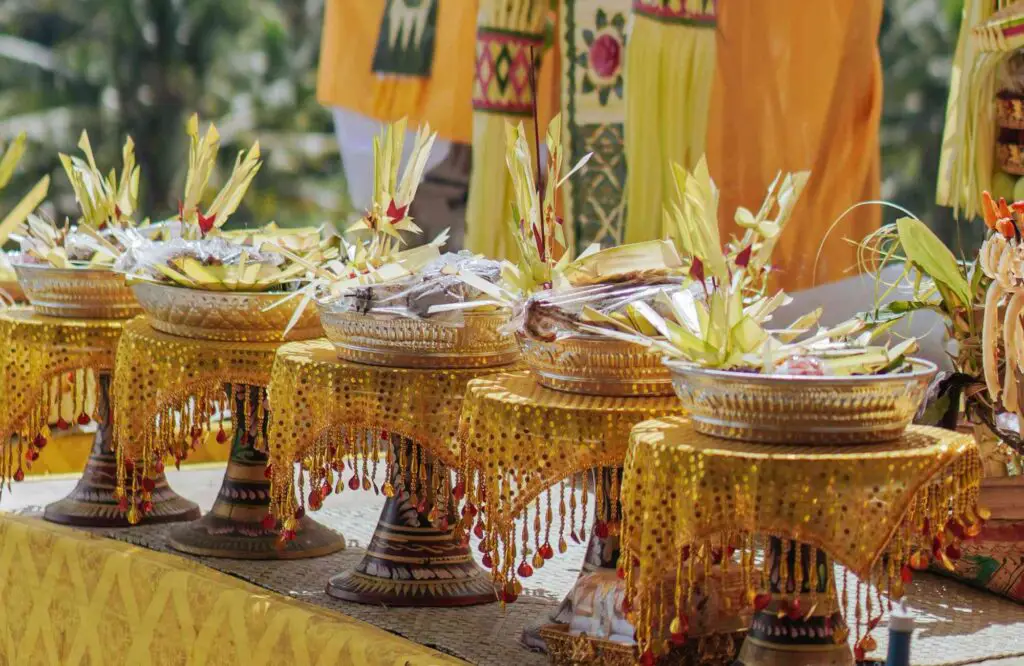
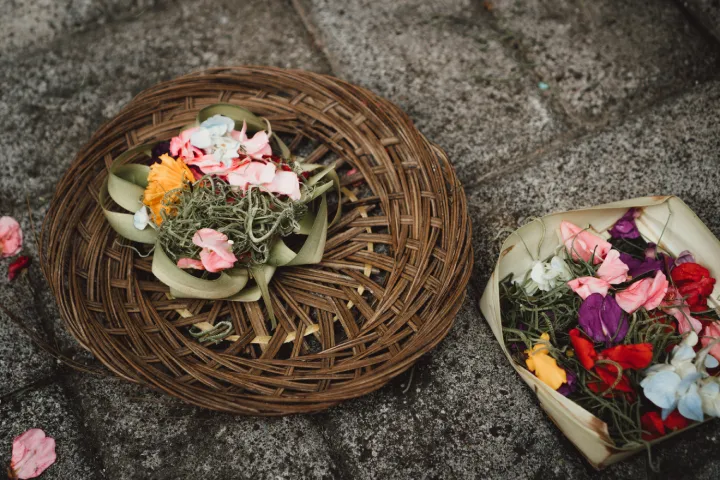
At around six in the morning in Sukawati, before the heat and long before the coast road fills, a woman steps out of her house with a small square of banana leaf in her hand. Inside it: a few flower petals, a pinch of rice, a stick of incense. She sets it on the ground near the gate, waves the smoke toward the house with her fingers, and goes back inside. The whole thing takes ninety seconds.
She does it on good days and bad ones. She does it when she has slept badly, when there is money trouble, when someone in the family is sick. Nobody asks whether she feels like it first, because feeling like it was never the qualification.
Visitors watch this from a distance and read it as devotion, which it is. What is harder to see is that it is also a theory of happiness — and a completely different one from the theory most of us were raised on.
- The Trouble With Treating Happiness as a Destination
- Tri Hita Karana: Happiness as Three Relationships
- Why Repetition Matters More Than Intensity
- What Changes When Joy Becomes a Practice
- How a Week in Sukawati Is Built Around This Idea
- Taking the Practice Home Without Borrowing the Culture
- Frequently Asked Questions
- What does Tri Hita Karana mean?
- Do I need to be religious or spiritual to join a happiness retreat in Bali?
- Is a happiness retreat the same as a meditation retreat?
- How long do the effects of a retreat last?
- Can I come if I am going through something genuinely difficult?
- Is it appropriate for visitors to take part in Balinese rituals?
- How does the Path to Happiness Retreat differ from Bodhi Leaf’s other retreats?
- Ninety Seconds
The Trouble With Treating Happiness as a Destination
The feeling that keeps leveling off
Most of us learned early that happiness is something you arrive at. Finish the degree, land the role, meet the person, buy the house, and a certain steady contentment is supposed to switch on and stay on.
And each of those things does lift you. That part is real. What surprises people is how reliably the lift settles. Within weeks the new job is simply the job, the new city is simply where you live, and the baseline you were trying to escape has quietly reassembled itself around the improved circumstances. You are not doing it wrong. It is just what happens when a feeling is asked to behave like a destination.
The uncomfortable part is what comes next. If arriving did not work, the obvious conclusion is that you have not arrived far enough — so you set a further target, and the cycle collects another lap.
The loneliness of a private project
There is a second problem, and it is more recent. Somewhere in the last few decades happiness became a personal performance metric. There are trackers for it, protocols for it, morning routines optimized for it. All of that can be useful. But it quietly hands you full ownership of an outcome, which means that when the feeling does not arrive, the shortfall reads as a character flaw.
By the time people write to us, that self-blame is often louder than the flatness itself. The sentence we hear most is some version of: I have done everything right, and I still feel like this. Our article on how to heal burnout looks at the same exhaustion from a different angle.
Bali would find the sentence strange. Not unkind — strange. Because in the Balinese view, happiness was never a private possession you could be individually bad at holding.
Tri Hita Karana: Happiness as Three Relationships
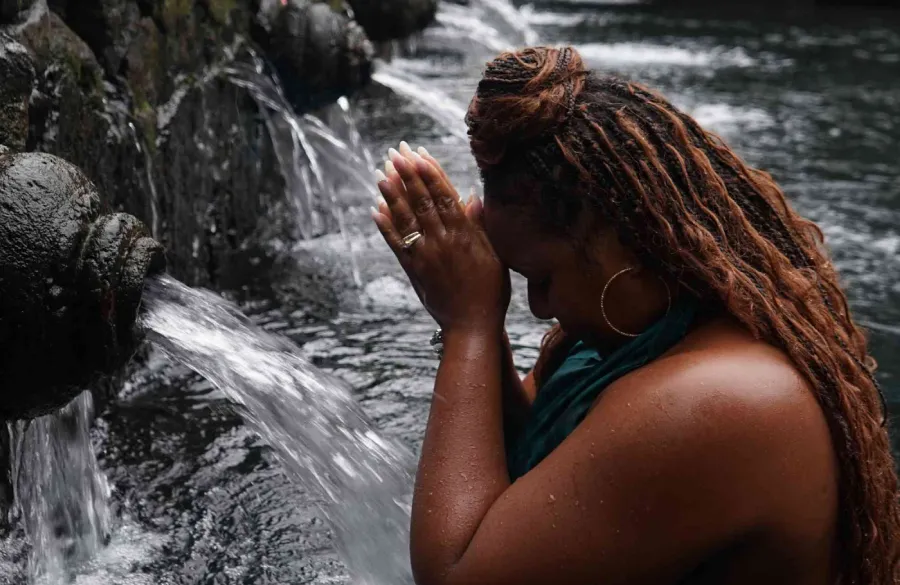
Photo by The Bodhi Leaf Wellness Resort
There is a phrase you will see carved into gateways and printed in village halls across the island: Tri Hita Karana. It translates, roughly, as the three causes of wellbeing. Harmony with the divine. Harmony with other people. Harmony with the natural world.
It is worth sitting with what that framing does. Happiness is not located inside you, waiting to be unlocked by the correct internal adjustment. It lives in the condition of three relationships. When it goes missing, the diagnostic question is not what is wrong with me but which of the three has gone quiet.
Parahyangan: the relationship with something larger
The first is the relationship with the sacred. In Bali this is visible everywhere — the offerings, the temple days, the calendar that bends around ceremony rather than the other way round.
You do not have to adopt anyone’s theology to take something from this. The transferable part is the posture: the daily reminder that you are not the largest thing in your own life. People carrying a great deal tend to be carrying it as though the whole structure depends on them personally. An hour in a temple courtyard where the ritual has been running for centuries and will keep running after you leave does something to that assumption — usually something like relief.
Pawongan: the relationship with people
The second is community, and this is where the contrast with imported wellness culture is sharpest. Balinese ceremony is labor, and it is shared labor. The offerings for a temple anniversary are made by dozens of hands over days. The banjar, the neighborhood association, turns out for cremations and weddings whether or not anyone is in the mood.
Meanwhile the wellness most of us practice at home is solitary by design: headphones in, door closed, a private hour reclaimed from a demanding day. Restorative, certainly. But it treats other people as the thing you are recovering from rather than part of what recovers you.
One of the quieter surprises of a retreat here is how much of the restoration turns out to be social — meals at a long table, being looked after by people who are not doing it as a performance, spending a week in the company of others without having to explain yourself.
Palemahan: the relationship with place
The third is the relationship with land. Bali’s rice terraces are irrigated through the subak, a water-sharing system organized around temples and neighbors and centuries of accumulated agreement about who gets water when. Nature here is not scenery. It is a party to the arrangement.
Most of us live at a considerable remove from any specific piece of ground. We know the weather from a screen. Waking to actual sunrise over actual rice fields, walking the same path daily until you notice which birds arrive at which hour, is not decoration around the healing work. For many guests it is the healing work.
None of this is presented as a clinical framework or a substitute for professional care. It is a cultural lens, several centuries old, that happens to point at things the modern version of happiness tends to leave out.
Why Repetition Matters More Than Intensity
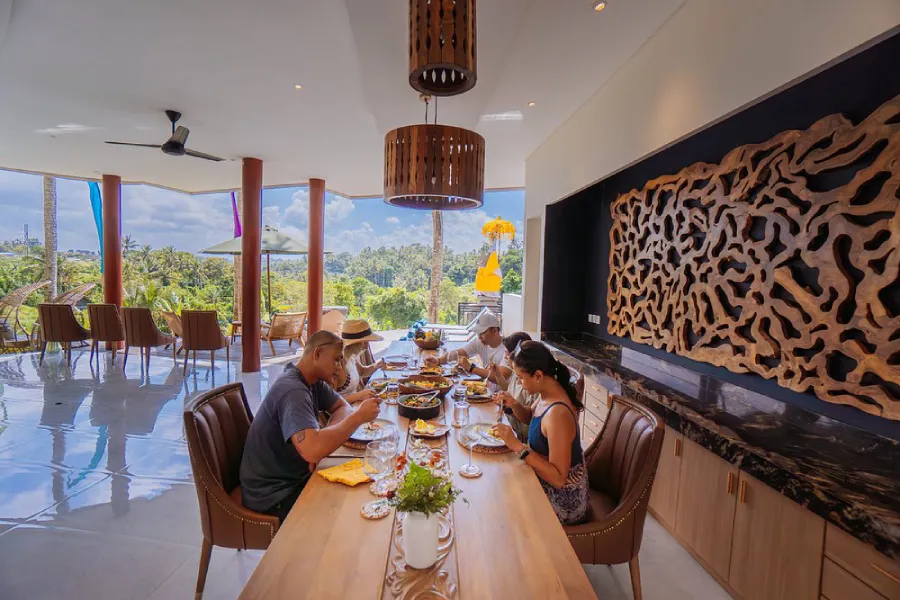
Photo by The Bodhi Leaf Wellness Resort
Return to the woman with the banana leaf.
The most instructive thing about that offering is not its beauty. It is its frequency. She will do it again tomorrow, and the day after, and next year, thousands of times, and no individual instance is meant to be transformative. The practice is the point. The mood is optional.
This runs directly against how transformation is usually sold to us. The dominant model is intensity: the breakthrough weekend, the extreme protocol, the single overwhelming experience that reorganizes everything afterward. Intensity makes for a better story. It has a weaker track record.
Bali’s model is unglamorous by comparison. Small things, done constantly, whether or not they feel meaningful on the day. Ceremony as maintenance rather than emergency response.
This is why a week matters more than a session, and also why the week is built the way it is. Seven days is not long enough to deliver a permanent state. It is long enough to run a rhythm often enough that your body stops treating it as an interruption — and long enough for you to feel, from the inside, what a maintained life actually feels like. Guests hoping for one enormous moment sometimes leave slightly puzzled and then find, three weeks later at home, that they are still getting up before the phone.
What Changes When Joy Becomes a Practice
You stop auditing your mood
When happiness is the target, you check the gauge constantly, and the checking itself is corrosive. Am I enjoying this? Should this feel better than it does? Practice removes the question. You do the thing. The feeling comes when it comes, and its absence on a given morning stops being evidence of anything.
You stop needing the day to be extraordinary
A great deal of unhappiness is really the exhaustion of maintaining a life that must justify itself continuously. Under a practice model, an ordinary Tuesday is not a shortfall. It is simply Tuesday, and it counts.
Small acts start to carry weight
Ninety seconds is nothing. Ninety seconds every morning for thirty years is a life with a spine running through it. What people tend to bring home from Bali is not the ceremony but the discovery that something very small, kept faithfully, does more than something very large, done once.
How a Week in Sukawati Is Built Around This Idea
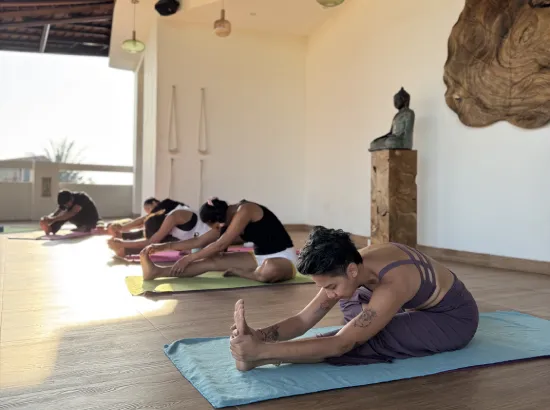
Photo by The Bodhi Leaf Wellness Resort
None of this is philosophy that stayed on paper. It is the reason the Path to Happiness Retreat is shaped the way it is.
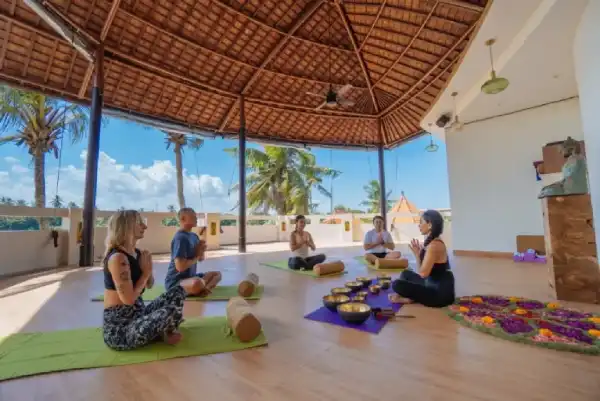
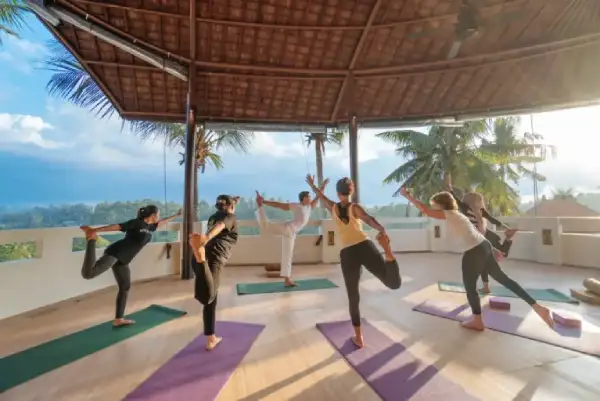
The mornings repeat deliberately. Yoga and meditation at a similar hour each day, the same slow breakfast afterward, are not there to fill a schedule — they exist so that repetition can do the thing repetition does. The ceremonies are led by Balinese healers and priests for whom these are ordinary practice rather than a performance arranged for guests; Bodhi Leaf was founded by Putu Maryam, whose family line traces to the Balinese Royal Family of Karangasem, and that lineage is why the rituals here are the real article rather than an approximation of one. Meals are taken together at a shared table, which is pawongan quietly at work. And everything sits on one property above the rice fields, so the days do not fragment into transfers across the island — palemahan, likewise, without needing to be announced.
The spa treatments and healing sessions support the week rather than headline it. And nothing here asks you to believe anything. You are invited to be present at practices that belong to the people leading them, which is a different and much lighter request.
If you want the day-by-day specifics — what each ceremony involves, what is included, what the week costs — the retreat page lays it out properly. This article is the reasoning underneath it.
Taking the Practice Home Without Borrowing the Culture
A necessary caution. The offering at the gate is not a technique to be extracted and repurposed; it belongs to a living religion, in a specific place, practiced by people with a right to it. Copying the ritual is not the goal, and doing so without belonging to it tends to hollow out both parties.
What does transfer is the shape. Something small, done daily, regardless of mood — five minutes outside before the phone, a candle lit at the same hour, tea made properly rather than absently. Something regular with other people, where you are not the beneficiary but a participant: a standing dinner, a shared task, showing up for someone whether or not the week has been kind. And something that keeps you in relationship with a specific piece of ground — one walk, one route, one patch of sky you know well enough to notice when it changes.
Three relationships, tended at whatever scale your actual life allows. That is the whole export, and it is portable.
Frequently Asked Questions
What does Tri Hita Karana mean?
Tri Hita Karana is a Balinese Hindu philosophy usually translated as the three causes of wellbeing: harmony with the divine, harmony with other people, and harmony with the natural world. It underpins much of daily life in Bali, from temple ceremonies to the way rice fields are irrigated, and it treats wellbeing as a matter of relationships rather than individual achievement.
Do I need to be religious or spiritual to join a happiness retreat in Bali?
No. Guests are invited to be present at ceremonies led by Balinese healers and priests, not to adopt any belief system. Many arrive with no spiritual practice at all and simply take part respectfully. What is asked is openness and courtesy toward traditions that are actively lived by the people guiding them.
Is a happiness retreat the same as a meditation retreat?
Not quite. A meditation retreat generally centers on sustained silent practice and can be quite austere. A happiness or emotional-wellness retreat in Bali weaves several elements together — daily movement and meditation, traditional ceremony, bodywork, shared meals, and cultural immersion — with none of them dominating. The experience is warmer and more social than most meditation intensives.
How long do the effects of a retreat last?
That depends far more on what you keep doing than on what happened during the week. Retreats that promise a permanent state are overselling. What a week can realistically do is give you a felt reference point — an experience of a differently paced life — and a few practices simple enough to survive contact with an ordinary schedule. Guests who maintain even a small daily version tend to describe a much longer tail.
Can I come if I am going through something genuinely difficult?
Many guests do, and the small group size and private one-on-one session exist partly for that reason. It is worth saying plainly that a retreat is not medical or psychological treatment and should not replace it. If you are working with a therapist or doctor, keep that support in place, and let us know in advance what would help so the week can be arranged around you rather than the other way round.
Is it appropriate for visitors to take part in Balinese rituals?
It is, when the invitation comes from the community rather than a marketing brochure. The distinction to look for is who leads the ceremony and whether it exists independently of tourists. Ours are led by Balinese practitioners for whom these are ordinary practice, and they follow customary rules — including the observance that guests who are menstruating do not enter temple grounds for purification ceremonies. Our guide to finding authentic spiritual retreats in Bali covers how to tell the difference.
How does the Path to Happiness Retreat differ from Bodhi Leaf’s other retreats?
The Path to Happiness Retreat leans toward emotional reconnection and joy, with ceremony and cultural immersion carrying much of the week. The Nervous System Reset Retreat is quieter and more physiological in emphasis, better suited to someone whose main experience is depletion rather than flatness. If you are unsure which fits, a short conversation through our contact page will sort it out faster than reading further.
Ninety Seconds
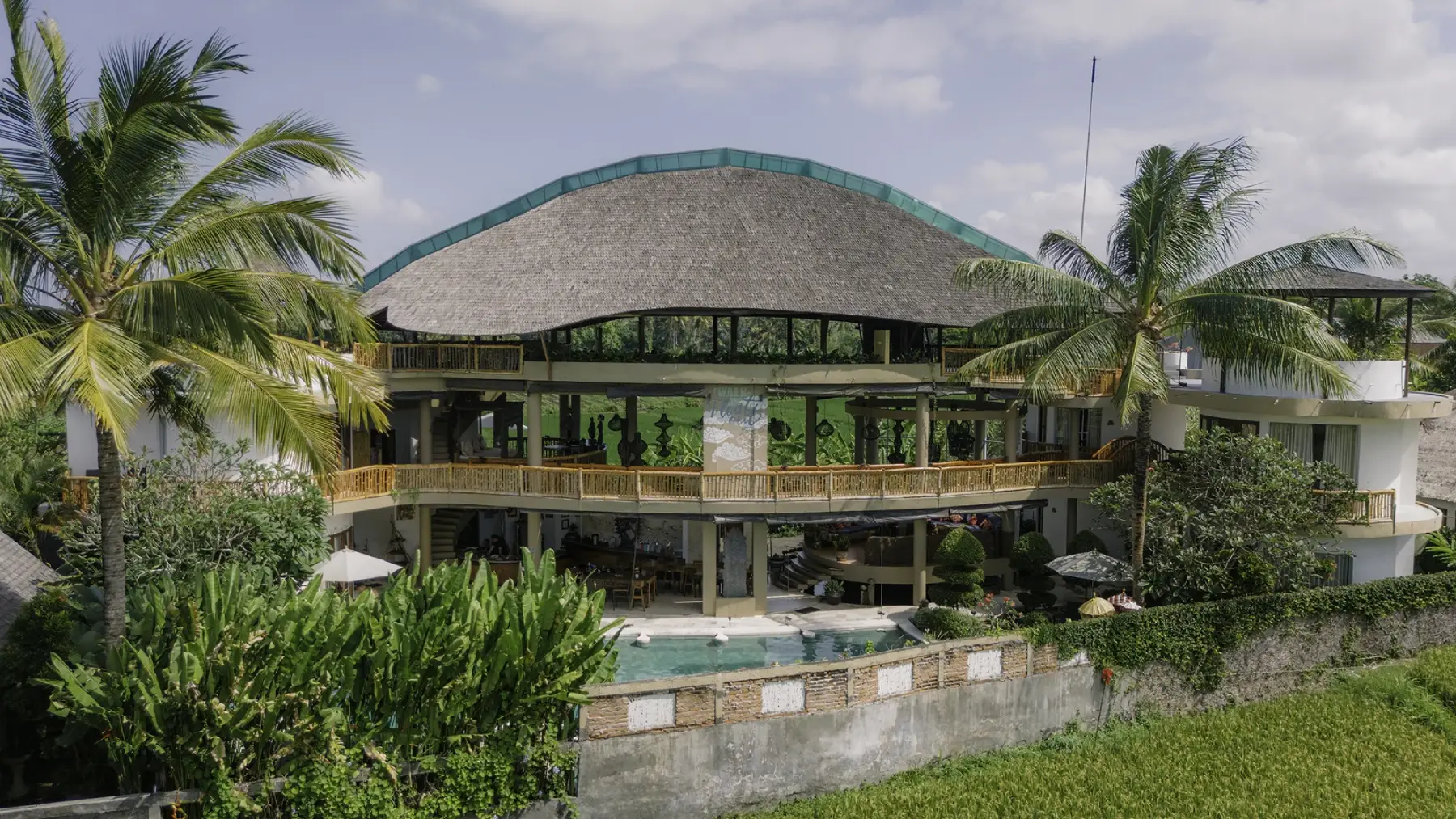
Photo by The Bodhi Leaf Wellness Resort
The woman at the gate is not happier than you because Bali is beautiful. She is not necessarily happier than you at all. What she has is a relationship with something larger, a village that turns out for her, a piece of land she knows in her body — and a small daily act that keeps all three in repair whether or not the morning felt promising.
None of that requires a plane ticket. But a week where it is practiced around you, by people who have never known it any other way, is a fast way to understand what has been missing and what the shape of a repair might be.
Sukawati keeps its own rhythm. When you are ready, it is there.