The Bodhi Leaf Approach:
A Journey Back to Yourself

Home » The Bodhi Leaf Approach

Most people who come to Bodhi Leaf don’t arrive knowing exactly what they need.

They arrive knowing something has to change.

Maybe it’s the exhaustion that sleep stopped fixing months ago. Maybe it’s the feeling of being completely functional on the outside and completely empty on the inside. Maybe it’s a relationship that needs space, a grief that hasn’t been sat with, a life chapter that closed without much ceremony, or simply the growing sense that you’ve been running so fast you’ve lost track of who you’re running as.

We’ve heard all of it. We’ve welcomed all of it.

The Bodhi Leaf Approach isn’t a program or a protocol. It’s a philosophy — one that shapes how we design every retreat, how we train our team, how we plan your meals, and how we respond when you tell us what’s really going on.

It comes down to five movements, each one building on the last.
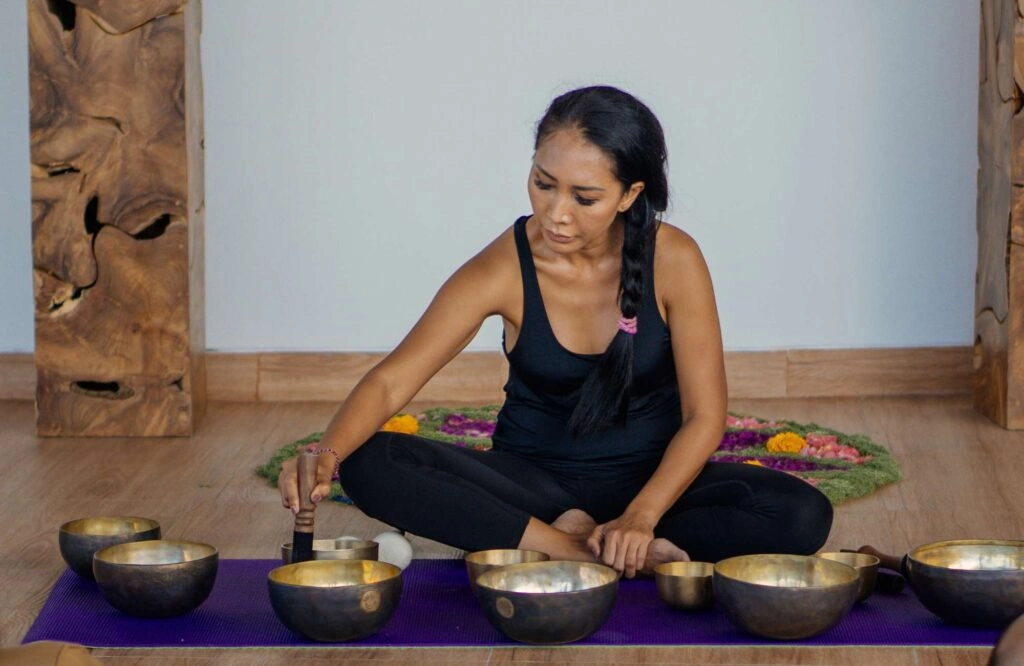
A woman with dark hair in a braid sits cross-legged on a purple yoga mat, surrounded by several singing bowls of varying sizes. She holds a wooden mallet, appearing ready to play the metallic bowls arranged before her on a light wood floor.
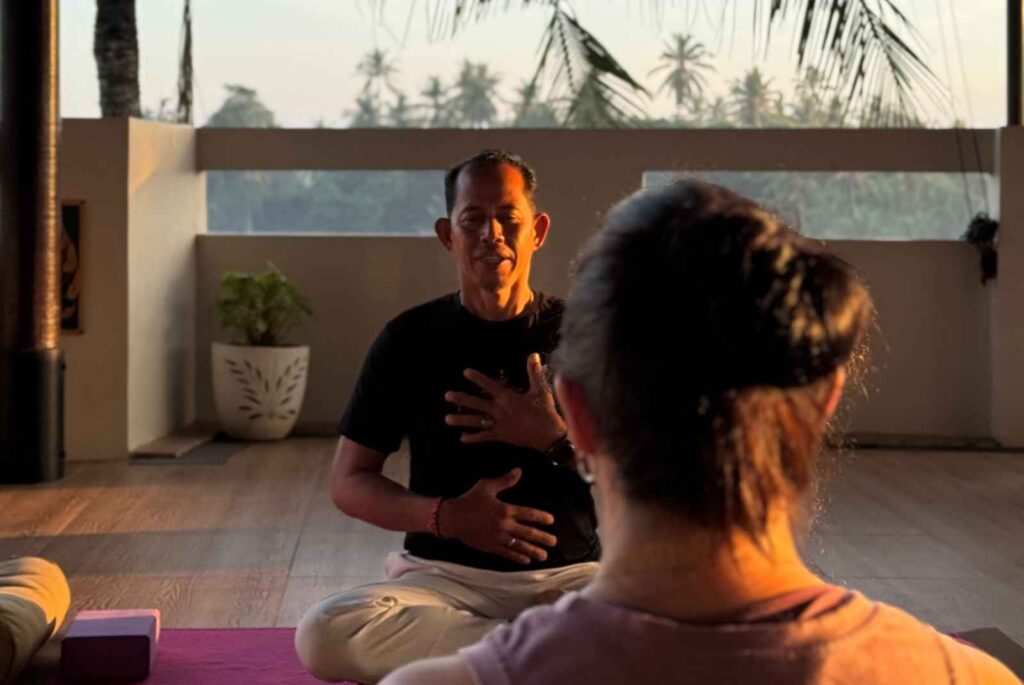
Two people sit cross-legged on yoga mats in a sunlit, open-air studio, each using bolsters and blocks for support during a meditative or restorative yoga session. The space features wooden floors, white walls with hanging ropes, and large windows framing palm trees and warm sunlight.

The five movements:

01 — Pause

The first and most radical act.

Before any healing can happen, something has to stop.

Not forever. Not in a dramatic way. Just long enough for your body to register that the pressure is off — that for the next few days, there is nowhere to be, nothing to produce, and no version of yourself you need to perform.

For most guests, this is harder than it sounds. The first day at Bodhi Leaf is often described as disorienting in a good way. The quiet feels foreign. The lack of urgency feels almost uncomfortable. That discomfort is useful — it’s the nervous system beginning to notice the difference between now and the life it just stepped out of.

Arriving is its own practice. We don’t rush it.

Your first day has no agenda. A warm welcome, a nourishing meal, your room.

Time to simply land.

02 — Regulate

The body remembers safety before the mind does.

Regulation is what happens when your body is finally given the right conditions to shift out of chronic stress and back into something that resembles ease.

This doesn’t happen through thinking. It happens through the body.
At Bodhi Leaf, regulation comes through breathwork that works directly with the nervous system, gentle movement and yoga sequenced to open rather than exhaust, Balinese bodywork and healing treatments that release held tension, sound healing that works at a frequency the thinking mind can’t reach, and the simple, consistent rhythm of being somewhere that feels safe.

Day by day, the accumulated stress of months begins to metabolise. Sleep deepens. Appetite returns. The reactive edge softens.

“Every step of the program was designed and set-out to maximise the outcomes and give you all that is needed in this situation — and allow you to reflect and heal on your own with no outside distractions.”
— Nicole G, April 2026 — Nervous System Reset Retreat

This is what regulation looks like in practice. Not a dramatic breakthrough. A quiet, steady return.

03 — Restore

You cannot heal in the same environment that exhausted you.

Restoration is the accumulation of everything a depleted body is quietly asking for and rarely gets: enough sleep, real food, time in nature, beauty, ceremony, and care that isn’t transactional.

At Bodhi Leaf, restoration is built into every hour of your stay.

The food is prepared from ingredients sourced through Bodhi’s Farm — nourishing by design, not by trend. There is no eating at a desk, no scrolling through lunch, no meals taken standing up. You eat slowly, outside if you want, without agenda.

The property itself — tucked into the rice fields of Sukawati, Gianyar — does a significant portion of the work. The climate, the quiet, the quality of light, the sound of nature instead of traffic — these aren’t background details. They’re part of the program.

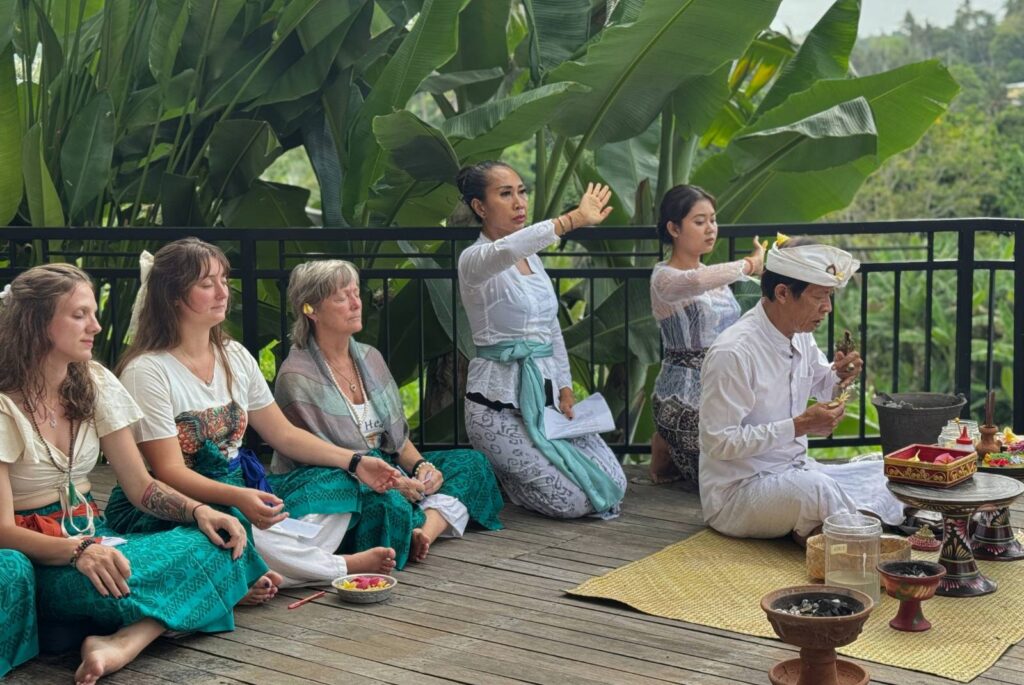
Balinese healing traditions, which have been caring for people for centuries, run through every treatment and ceremony we offer. This isn’t appropriation — it’s the genuine offering of a lineage founded by Putu Maryam, whose roots trace to the Balinese Royal Family of Karangasem, and whose intention in founding Bodhi Leaf was to share authentic healing with those who need it.

Restoration takes as long as it takes. We don’t put a schedule on it.

04 — Reconnect

The noise quiets. Something else becomes audible.

Once the nervous system has begun to regulate and the body has begun to restore, something else tends to happen that guests often find difficult to explain in advance.

They hear themselves again.

Not the version of themselves that manages, performs, copes, or optimises. The version underneath — the one that knows what they actually need, what they actually value, what was actually missing.

For solo guests, this often arrives quietly: in a morning session, during a meal, or in the long afternoon when there’s nothing required. For couples, it often arrives as the first real conversation they’ve had in longer than either can remember. For guests going through a life transition — the end of something, the beginning of something, a grief that’s been postponed — it often arrives as unexpected clarity.

We don’t engineer this. We create the conditions for it. The space, the safety, the right questions at the right moment, and the experience of being genuinely seen by a team whose job is to pay attention to you.

“Through my time at The Bodhi Leaf, I reconnected with a part of myself I had lost. I found inner peace, self-love, and a deep sense of freedom. I left feeling whole again.”
— Diane N, United States

05 — Begin Again

The retreat doesn’t end when you fly home. It starts there.

The final movement isn’t something that happens at Bodhi Leaf. It’s something you take with you.

Tools for managing what depleted you. A clearer sense of what you need and what you can let go of. Practices — breathwork, movement, intention — that your body now knows how to use because it has experienced what they do. And a felt memory of what rest actually feels like, which becomes its own compass.

“I see this as a gift back to myself.”
— Nicole G, April 2026 — Nervous System Reset Retreat

That’s what Begin Again looks like. Not transformation as a finished state. A new starting point.

Find the Right Retreat for Where You Are

Every retreat at Bodhi Leaf is built around the same five movements — but each one enters the arc at a different point, depending on what you need most right now.

Who This Is For

The Bodhi Leaf Approach was designed for the person who doesn’t fit neatly into a wellness category.

Not the person who needs a medical intervention. Not the person who wants a luxury spa holiday (though the accommodation is beautiful and the treatments are exceptional). The person in between — who is functioning, often impressively so, but who knows that something underneath is asking for attention.

That might look like:

  • Chronic exhaustion that rest isn’t fixing
  • Anxiety or a nervous system that won’t settle
  • A life transition with no space to process it
  • A relationship that needs reconnection rather than another weekend away
  • The feeling of being out of alignment with yourself without quite knowing how you got there
  • The knowledge that you’ve been last on your own list for too long

Bodhi Leaf is not a clinic. We don’t diagnose, and we won’t promise outcomes. What we can promise is this: we will meet you exactly where you are, design your stay around what you actually need, and give you the space to do the work — or to rest — in equal measure.

A person with gray nail polish writes in a spiral-bound notebook on a wooden table, accompanied by a ceramic coffee cup and saucer and a white ceramic jar.
yoga bali

Frequently Asked Questions

No — and most guests don’t. The free consultation exists precisely for this. A short conversation about where you are and what you’re looking for is usually enough to point you toward the right fit. We’ll never push you toward a more expensive option if something simpler is what you actually need.

The philosophy is the same — every retreat moves through some combination of Pause, Regulate, Restore, Reconnect, and Begin Again. What changes is where each program enters the arc and how long it spends in each stage. A Rest & Recharge stay focuses almost entirely on Restore. A Transformational Healing Retreat moves through all five. The Approach is the frame; the retreat is the specific path.

This is more common than people expect, especially in the first day or two. The body needs time to register that the pressure is genuinely off — and for guests who have been running on adrenaline for months, that process can feel like nothing at first. It’s not nothing. It’s the earliest stage of Pause doing its work. Most guests find that something shifts by day two or three, often quietly and unexpectedly. We don’t manufacture experiences; we create conditions.

Yes. Many of our guests arrive in the middle of something significant. Bodhi Leaf is not a clinical setting and we don’t provide therapy or medical care, but the Reconnect stage of the Approach is specifically designed for people in transition — those processing loss, change, or the end of one chapter and the uncertainty of the next. If you’re carrying something significant, mention it when you contact us and we’ll make sure the program is shaped appropriately.

Yes. No prior experience is required or expected. Sessions are adapted to where you are, not where a program assumes you should be. The physical practices at Bodhi Leaf are gentle and accessible — the goal is to open the body and settle the nervous system, not to perform or achieve a posture.

A spa resort offers treatments. Bodhi Leaf offers a program — a sequenced, intentional experience designed to produce a specific outcome: a nervous system that has genuinely rested, a guest who feels more like themselves than when they arrived. The treatments are part of that, but they’re not the whole thing. The difference shows up in the meals, the pacing, the structure of each day, and the quality of attention from the team. It’s the difference between a massage and a healing retreat.

You don’t need to know exactly what you need.

That’s what the conversation before booking is for.