
If you’re depleted, overwhelmed, or going through something significant, three options tend to come up: book a holiday, see a therapist, or go on a retreat. All three can be valuable. None of them is interchangeable.
Here is an honest account of what each one actually delivers, where each one has limits, and how to figure out which is right for where you are right now.
What a Holiday Delivers
A holiday is a change of environment, stimulation, and experience. Done well, it produces genuine pleasure, new perspectives, and a break from routine. These things are real and worthwhile.
What a holiday doesn’t change: the internal conditions you return to. After the trip, the same patterns, pressures, and physical state you left are waiting. Your nervous system didn’t reset — it had a break. The boss is still in your inbox. The chronic tension in your shoulders came with you on the plane.
This is not a criticism of holidays. They’re appropriate for what they are: rest, pleasure, experience. The problem arises when someone uses a holiday to address something a holiday was never designed to fix — and is confused when it doesn’t work.
If you come back from a two-week trip and feel almost immediately back to where you started, that’s information. The issue isn’t the holiday. The issue is that the depletion runs deeper than a change of scenery can reach.
What Therapy Delivers
Therapy — psychotherapy, CBT, counselling, somatic therapy — is a clinical or quasi-clinical relationship with a trained professional focused on specific psychological processes: changing thought patterns, processing trauma, addressing diagnosable mental health conditions, developing coping strategies. Psychology Today on somatic therapy provides a useful overview of the range of therapeutic modalities and what each addresses.
Therapy is the right tool when: you’re experiencing a diagnosable mental health condition, you’ve been through trauma that needs professional processing, you’re in active crisis, or you need ongoing clinical support over months or years.
What therapy typically doesn’t provide: the physical environment of removal from daily stressors, the embodied experience of nervous system regulation through movement and somatic practice, nourishment and sleep in a supportive container, or the concentrated immersive effect of being somewhere completely different for a period of time. Therapy happens in a room, usually once a week. A retreat happens all day, every day, for several days.
American Psychological Association notes that for many stress-related conditions, a combination of clinical support and environmental change produces better outcomes than either alone. These are not competing options.
What a Retreat Delivers
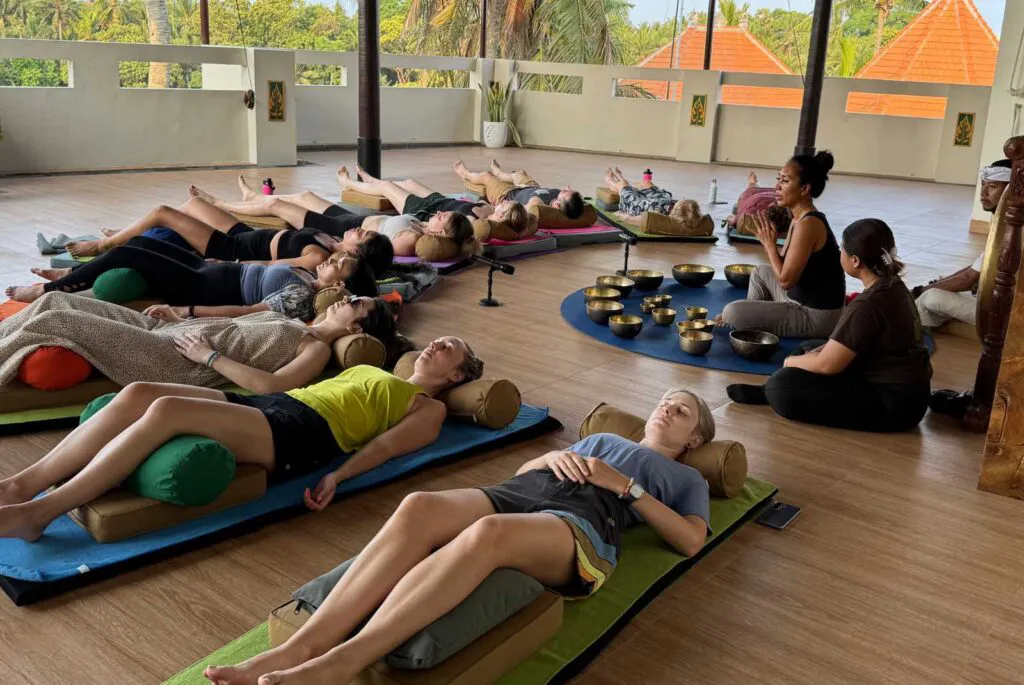
A retreat sits between a holiday and therapy — not a clinical product, not a passive experience. It’s a structured residential program with a specific intended outcome, delivered in an environment that removes the daily stressors while actively working on the internal conditions that maintain them.
A retreat changes: the environment (you’re somewhere else, with no commute and no household management), the rhythm (structured days that don’t require decision-making), the inputs (real food, movement, healing practices), and crucially — the nervous system’s baseline. This last element is what a holiday cannot replicate and therapy alone rarely produces in the same compressed timeframe.
The The Bodhi Leaf Approach at Bodhi Leaf is built on five movements: Pause, Regulate, Restore, Reconnect, Begin Again. Each one addresses a layer that either a holiday or therapy would typically touch only partially.
The Honest Comparison
Holiday: stimulation and pleasure, breaks routine, does not change internal conditions, appropriate for rest and experience, not for processing or healing.
Therapy: clinical depth, addresses specific psychological patterns and conditions, ongoing relationship over time, appropriate for mental health conditions, trauma, or as long-term support.
Retreat: immersive and embodied, addresses the nervous system and physical state alongside emotional processing, concentrated over days rather than weeks, appropriate for burnout, depletion, life transitions, and as a reset that produces tools for ongoing use.
Common Situations — Which Fits Best
‘I’m exhausted and haven’t felt like myself in months’
This is where a retreat, specifically our Nervous System Reset Retreat or Rest and Recharge Package, is often the most direct fit. The exhaustion usually has a nervous system component that neither a holiday nor talk therapy addresses as efficiently.
‘I’m going through a major life transition’
A retreat is particularly effective here — the time and space to process a transition is something that’s very hard to manufacture in daily life. Our Path to Happiness Retreat and the 3 Nights Transformational Private Healing Retreat are both designed to support this kind of inner work.
‘I’ve been diagnosed with depression or anxiety’
Speak to your treating clinician first. A retreat can complement clinical support but is not a replacement for it. If your mental health professional thinks a structured wellness retreat could be beneficial alongside your treatment, we’re happy to discuss what that looks like.
‘I just need to switch off for a week’
Consider whether a holiday might be the simpler answer — and if you come back feeling much the same, return to this article. If what you’re describing is more than wanting to switch off, our Silent Meditation Retreat offers a program specifically designed for deep quiet.
‘I’ve tried therapy and it helped, but I feel stuck again’
This is a common pattern. Therapy provides insight and tools; a retreat provides the immersive environment to actually use them, often breaking a cycle that talking about it alone hasn’t shifted.
They Can Work Together
Many of our guests are in therapy before, during, or after their retreat — and find the combination more powerful than either alone. A therapist can help you prepare for what the retreat might surface. A retreat can give your therapy something new to work with. These aren’t competing modalities.
The guest who arrives with the clearest intention — who has thought about what they’re hoping to address and discussed it with their therapist — often has the deepest experience.
Frequently Asked Questions
Can I do both therapy and a retreat at the same time?
Yes — and many guests do. If you’re in ongoing therapy, letting your therapist know you’re going on a retreat is useful. Some people schedule a session shortly after returning to integrate what came up. The retreat and the therapeutic relationship can feed into each other productively.
I’ve never done yoga or meditation. Is a retreat still for me?
Yes. No prior experience is required. Our programs are designed for people arriving without any wellness background — sessions are accessible and adapted to where you are. The goal is to open the body and regulate the nervous system, not to achieve specific postures or states.
Is a retreat appropriate if I’m on medication for anxiety or depression?
Generally yes, though we always recommend mentioning your medication to us before booking so we can make sure the program is designed appropriately. Some practices — particularly breathwork — are modified for guests on certain medications. We’re not clinicians and won’t advise on medication, but we will accommodate your needs. If in doubt, check with your prescribing doctor. NHS guidance on burnout provides guidance on when medical input is needed.
What if I need more support than a retreat can offer?
We’ll tell you. If during our consultation or during your program it becomes apparent that what you’re navigating needs clinical support, we will say so clearly and, where possible, help you find the right next step. We’d rather refer you than hold you in a context that isn’t appropriate.
How is a retreat different from a wellness spa?
A spa offers treatments. A retreat offers a program — a sequenced, intentional experience with a specific outcome. The treatments are part of it, but they sit within a structure that includes your meals, your sleep, your movement practice, and your time — all designed to work together. The difference shows up most clearly in how you feel when you leave.
Not sure which is right for you right now?Talk to us. We’ll be honest about whether a retreat is what you actually need. |